Uban Pest Birds
These birds are regarded as the most important bird pests of the urban environment. Their significance will vary from country to country and other species will, from time to time, cause problems in towns and cities.
The Feral Pigeon (Columba livra).
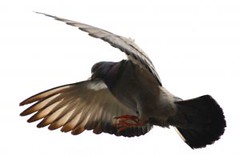
This is the number one urban pest bird throughout the world. Descended from birds which were originally domesticated for food, these birds have reverted to their wild state, but now live in close proximity to Man. Much loved by the general public, they are responsible for most of the bird fouling of buildings in towns and the transmission of bird diseases to humans such as ornithosis.
Scaring
No distress call has yet been isolated; scaring with auditory or visual systems is rarely successful for long.
Proofing
Many systems are available, but great care must be taken with product choice for each part of the building. Netting with 50mm meshnet is the most successful method.
Control
Can be a good option for removing specific individuals; large-scale culling is rarely successful for long and incurs very significant adverse public reaction. Removal of food and shelter will help.
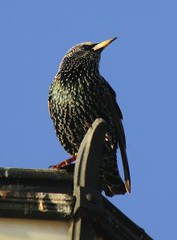
The Starling (Sturnus vulgaris)

This can be a major problem in certain localities and of no significance in others. The problem occurs when large numbers (can be tens of thousands) gather for night roosting. The noise, smell and extensive fouling caused by these congregations can be horrendous. Fungi associated with the dried guano can give rise to serious human disease problems.
Scaring
This species has a distress call, recordings of which can often be used successfully to prevent night roosting.
Proofing
Few systems are effective, due to the birds’ small size and agility, with the exception of 28mm mesh netting.
Control
Not usually a practical option, due to the sheer numbers of birds often present in the flocks.
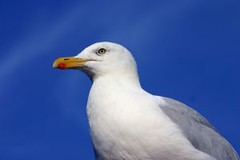
The Herring Gull (Larus arqentatus)

These large, aggressive birds are causing an increasingly significant problem due to their recent use of buildings as sites for breeding colonies. The noise, mess and smell associated with such sites can cause serious distress to those in the buildings concerned.
Scaring
This species has a distress call, but playing recordings of this back at the birds can have variable results.
Proofing
A number of heavy-duty systems are available, with netting using 100mm mesh being the most successful.
Control
Can be a good option for removing specific individuals; large-scale culling is rarely successful for long and incurs very significant adverse public reaction.
The House Sparrow (Passer domesticus)
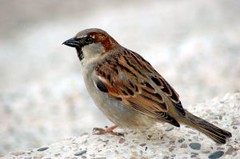
This is a major problem for the food industry, with populations becoming established inside warehouse and retail premises. These “flying mice” gain entry through very small holes and then damage and foul stored food and arc extremely difficult to deal with.
Scaring
No distress call has yet been isolated; scaring with auditory or visual systems is rarely successful for long .
Proofing
Few systems are effective, due to the birds’ small size and agility, with the exception of 19mm mesh netting.
Control
Can be a good option for removing specific individuals; some methods require Special Licenses (U.K.) Other birds which can also be urban problems from time to time include the Lesser Black-Backed Gull (Larus fuscus) Lapwing {Vanellus vanellus) House Martin (DeUchon urbica) Carrion or Hooded Crow (Corvus corone) Magpie {Pica pica). It is essential to check on the legal status of these birds before action.